It is clear in the field of social and emotional learning that studies have not yet examined how the lived experience of Black Americans are uniquely impacted by social and emotional learning programming and materials.
The need for Black SEL has arisen from the number of
disparities for African American people. Education, crime, social welfare, healthcare, and economics are all areas in which vast disparities exist between African American and White Americans (Moriel 2024, State of Black Americans). Durlak (2011) and Cipriano (2024) show the clear benefits of SEL.
Our work as a Black SEL organization over a course of five years has given us the privilege to impact thousands of Black students ages 13-18. Our direct work with these students has revealed to us that a significant number of Black students are (a) unaware of the value of SEL competencies (38%, 2004 Black SEL Report) and (b) can not connect these competencies to their lived experience (50% Black SEL Report).
We believe that in order for the African American community to truly benefit from SEL programming and the outcomes as referenced by Durlak (2011) and others (Cipriano, 2024, Greenberg 2003) that we must recognize that learning is dually social and emotional and contextual (Jones 2017). In the spirit of context, moving forward as SEL practitioners impacting black lives, we believe that future SEL work must be grounded in the black lived experience and subsequently critiqued, embraced, and owned by members of the African American community. It is in the space of context that Black SEL as an organization is poised to help measure, define, and use data for the pursuit of liberation for Black people. We practice liberation by building the bridge between SEL for all communities and the unique needs of Black people and creating cycles of learning through framework application, focused programming for youth and adults and applied research.
The Black experience in the United States in the western world is based on historical and systemic racism from slavery, colonization, and Jim crow AND one of reSELience from building social movements, cooperative economic structures, and culture that prioritizes and heals Black people. Black SEL is about acknowledging the ways that SEL competencies have been present in black communities long before the designation or study of social-emotional learning.
Black SEL’s Glossary of Terms and definitions that support our work (mission/purpose) and efforts towards Social Emotional Liberation.
Our Black SEL Framework is rooted in research that affirms our stories and lived experiences. Hover over each pillar in the image below to explore the supporting articles connected to that area. Move through it at your own pace and discover the scholarship that strengthens this work.
![]() |
Black Self Concept |
![]() |
Inclusion of Community Stakeholders |

![]() |
Critical Consciousness |
| Black Social & Emotional Learning |
| Lived Civics | ![]() |

| Civic Engagement | ![]() |
| Social Responsibility | ![]() |
| POWER |
| ACTION |
| SUSTAINABILITY |
The self-perception and identity that Black individuals hold, shaped by their racial and cultural experiences. It encompasses the ways in which Black people view themselves, their abilities, their worth, and their roles within both the Black community and the broader society. This concept is influenced by a variety of factors including family, community, media, historical context, and personal experiences with systemic racism and discrimination. A strong Black self-concept is often linked to a sense of pride, resilience, and empowerment, reflecting an understanding and appreciation of one’s heritage, culture, and individual potential.
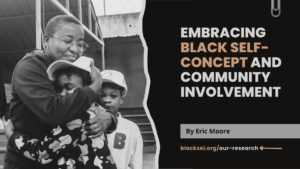
The active and intentional involvement of individuals or groups who have a vested interest or are directly affected by a particular issue, project, or decision-making process within a community. This concept emphasizes the importance of engaging diverse voices, perspectives, and expertise to ensure that all relevant stakeholders have a seat at the table and contribute to the planning, implementation, and evaluation of initiatives that impact them.
Lived civics is a critically relevant approach to civic education that positions the lived experiences, identities, and sociopolitical realities of youth, particularly race and ethnicity at the center of curriculum and instruction. It moves beyond traditional, formulaic, and often, whitestream civic education to examine power, oppression, and active, youth engagement in their communities.
The active participation of individuals in their communities to address social, political, and public issues. It involves efforts to influence decision-making processes, promote positive change, and improve the well-being of society through activities like voting, volunteering, community organizing, advocacy, and public service. Civic engagement empowers people to take responsibility for their communities and contribute to the common good.
The ability to critically analyze and understand the underlying power dynamics, social structures, and systemic injustices that shape society. It involves developing a deep awareness of one's own positionality within these systems and recognizing how they perpetuate oppression and inequality.
The ethical obligation of individuals, organizations, and institutions to act in ways that benefit society at large, beyond their own interests or profit motives. It encompasses a broad range of behaviors, policies, and initiatives aimed at promoting positive social, environmental, and economic outcomes.
Emphasizes culturally affirming practices that honor Black identity, history, and lived experiences. It strives to equip Black students and professionals with the tools to navigate systemic challenges while fostering emotional intelligence, self-awareness, and community-centered leadership.
Refers to the intentional steps that individuals take to integrate Social Emotional Learning (SEL) into their personal lives, with a focus on fostering the well-being, growth, and empowerment of Black people. It involves a commitment to self-awareness, self-management, and resilience, ultimately working towards collective action.
Creating long-term, systemic change that ensures Social Emotional Learning (SEL) is continuously relevant, accessible, and impactful for Black individuals and communities. It’s about building lasting structures that support the emotional well-being, cultural affirmation, and empowerment of Black students, educators, and leaders for generations.
From Self-Exploration to Liberation is a monthly blog series that examines the leadership development process for Black SEL Advocates. This analysis traces their journey from self-exploration to personal and collective liberation through a series of experiences provided by Black SEL Advocate Program for their Black SEL advocates. The blog systematically documents the advocates’ experiences and growth through the application of the Black SEL pillars in the Durham, North Carolina community.
Black SEL is a customized approach to social and emotional learning (SEL) that serves as a primary vehicle for cultural transmission, specifically tailored to the experiences, needs, and cultural contexts of Black students and communities.